
A Practical Guide to Mastering RCI_ZigZag: Three Steps to Turn Signals into Profit
In the previous article, we explained why the signal tool "RCI_ZigZag" is effective for many traders, focusing on the fusion at its core of the market structure (ZigZag) and the timing of entries (RCI).
This time, we will elevate that theory into practice. How to transform the arrow signals displayed on the chart into concrete "profits." We will introduce three
steps in a concrete and practical way.
Step 1: Signal selection — Increase win rate with "environment awareness"
First, I will share the most important mindset. It is that you do not enter on every signal.
"RCI_ZigZag" provides excellent entry opportunities, but to further improve the win rate of those signals, add a filter called "environment awareness." The simplest and strongest method is to check the trend of higher timeframes.
[Practical Rule]
For example, suppose you are trading on the 15-minute chart.
* If a buy (↑) signal appears:
Only consider entering if the higher timeframe, such as the hourly or 4-hour chart, is in an "uptrend." This aligns with the larger flow (main trend) and makes "buying on dips" much more likely to succeed.
* If a sell (↓) signal appears:
Similarly, if the higher timeframe is in a "downtrend," it becomes an excellent opportunity for a "sell on a rally."
Signals that go against the higher timeframe trend should be ignored, even if they appear, and must be met with the courage to pass. This alone can significantly reduce unnecessary losses.
Step 2: Building an exit strategy — profits are only realized upon exit
"RCI_ZigZag" tells you when to enter, but it does not provide exit (take profit or stop loss) functionality. To preserve profits in trades, you must clearly define an exit strategy before entering.
* How to set a stop loss
The most logical stop loss point is the ZigZag vertex (high/low) that formed the signal.
* For buys (↑): Place the stop slightly below the ZigZag low that triggered the signal.
* For sells (↓): Place the stop slightly above the ZigZag high that triggered the signal.
This allows you to minimize losses and exit when the rationale for the entry is invalidated.
* Concepts of take profit
There are several take-profit methods; here are two representative ones.
1. Determine by risk-reward ratio:
When the stop loss is set to 1, set the profit target to 1.5 or 2 (e.g., if stop is -20 pips, take profit is +30 pips). This enables disciplined money management.
2. Target the next milestone: set profit targets at the next anticipated resistance or support line, or at the next ZigZag reversal point.
Step 3: Parameter tuning — a journey to your personal optimum
This tool shines when you adjust its parameters to fit your trading style and the currency pairs you favor.
* Align with currency pair volatility:
For volatile pairs like GBP/JPY, setting ZigZag values a bit larger can reduce false signals and lead to more stable trading.
* Align with the time frame you trade:
For 5-minute scalping, use smaller values so it responds more quickly. For 1-hour day trading, use larger values to capture bigger waves; such adjustments are effective.
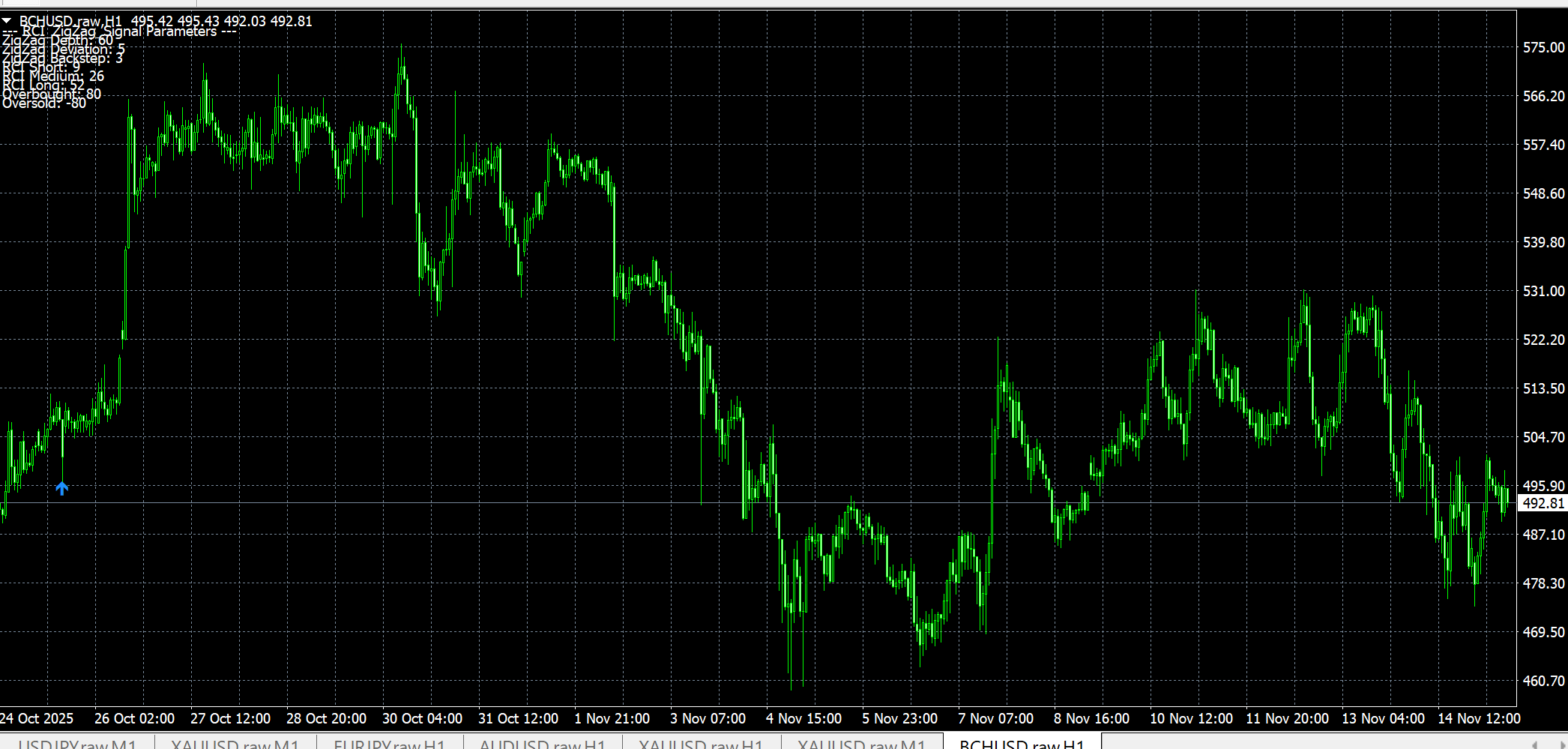
Please try using a demo account to test which currency pair, which time frame, and which parameter settings fit you. See
the feature that continuously displays parameters on the top-left of the chart to make this optimization journey more comfortable and meaningful.
Conclusion: Toward traders who “master” the tool
"RCI_ZigZag" is not merely a magic wand that waits for arrows.
1. Use environment awareness to select the “where” you should enter.
2. Use exit strategy to “confirm” profits.
3. Use parameter tuning to optimize the tool for yourself.
Through these steps, you will grow from a trader who merely “uses” the tool to a true trader who “masters” it. Please refer to this practical guide and build your own winning formula.
Create your own winning formula by following this practical guide.