
[FX Line Trade] Three practical methods to seize market "bonus opportunities" and a recommendation for automation
Is Line Trading Still Effective?
People often think, "Line trading is already old," but in fact it remains one of the simplest and most reproducible trading methods today.
Because what moves the market is not AI or logic, but ultimately “human psychology.”
And this psychology is most visible in price lines. At highs and lows, key levels, and price ranges that traders pay attention to, many traders think about entry and exit in the same way.
In other words, a line that “anyone would recognize as important” can itself be a high-win-rate point.
Why line trading creates “bonus opportunities”
The market does not move randomly all the time. Within big trends, there are certain cycles where “targetable waves” are born.
What you need to seize these “bonus opportunities” is an accurate way to draw the lines and a system that doesn’t miss the timing.
Just by drawing the lines, whether you can catch the moment when the entire market looks in the same direction as soon as price reaches there can greatly change your win rate and risk-reward.
Three concrete methods of line trading
From here, we’ll introduce three practical line-utilization methods that actually work.
① ZigZag Line Break Method
The ZigZag indicator visually organizes the chart’s “waves,” making it a very effective tool for beginners.
It displays only highs and lows that exceed a certain range, removing noise and capturing the market’s essential waves.
■ Basic logic
- Identify recent highs and lows with ZigZag
- Enter at the point it breaks that line on a close
- Only extract a small 5 pips in the break direction to take profit
With just this, you can repeatedly scalp the market’s “early moves.” ZigZag visualizes the beginning of a trend, making it ideal for momentum-driven short-term trading.
■ Tips on aiming
Check ZigZag on the 1-hour or 15-minute chart, refine entries on the 5-minute chart; emphasize whether the candle body has closed beyond the high/low updates; target for high-volatility periods (Europe and NY).
■ Cautions
Because ZigZag lines may move after confirmation, in real-time judgment only use the “confirmed peaks and valleys.” Also, if aiming for 5 pips, choose currency pairs with tight spreads (EURUSD, USDJPY, etc.).
■Advanced technique
Combining ZigZag with RSI/MACD divergences greatly improves accuracy in identifying reversals or continuations before a breakout. Particularly, pairing with RSI trendline breaks helps capture the early move without missing it.
② Fibonacci Break Method
Fibonacci retracement is a tool to measure how far a market might retrace after moving in one direction.
Because it clarifies turning points and pullback or reversal opportunities, it’s one of the more accurate methods within line analysis.
■ Basic logic
- Draw Fibonacci from the low to the high in an uptrend
- If the 23.6% level is clearly broken downward, treat as “pullback breakdown = short opportunity”
- Conversely, in a downtrend, draw from high to low and break above 23.6% for a long opportunity
By targeting moments when shallow retracements collapse, you can catch the early move of a trend reversal.
■ Tips on aiming
Use 23.6% and 38.2% as references to observe both “rebound or break”; don’t enter on a single break—wait for a retouch (retest) and a subsequent dip to improve accuracy; draw Fibonacci on daily and 4-hour timeframes and seek entry timing on 1-hour or smaller.
■ Cautions
The 23.6% line can show both rebounds and breakouts, and false breaks occur. Increase reliability by layering multiple confirmations (moving average crossovers, Bollinger Band expansions, etc.).
■ Advanced techniques
Using Fibonacci expansions together allows you to set numeric profit targets after a breakout. For example, “break 23.6% → take profit at 161.8%” can automate exits for consistency.
③ Round Number Break Method
Round numbers such as “1.3000,” “0.8500,” or “155.00” are price barriers that both professionals and retail traders pay attention to. At these levels, stops and take-profits cluster and prices react strongly, making breakouts highly powerful.
■ Basic logic
- Check price levels at 00 and 50 on major currency pairs
- Draw a line slightly above (or below) that level (e.g., 1.3005 or 0.8495)
- Enter on the breakout in the direction of the move
The reason for drawing slightly above/below is to avoid false breaks and respond only to true breakouts. Prices tend to bounce near round numbers, so aiming for the breakout just after the bounce is key.
■ Tips on aiming
Be mindful of round numbers on the 1-hour chart or higher; if they coincide with recent highs/lows and trendlines, breakout reliability doubles; particularly effective when the market shifts from range to trend.
■ Cautions
Round numbers often trigger mechanical reactions, so trading in low-volatility times can result in incomplete breakouts and reversals. Target high-liquidity windows such as London open or early NY sessions.
■ Advanced techniques
Combining round numbers with Bollinger Band sigma-3 breaks can yield “strong breakout plus psychological level突破,” enabling large moves in short time. Additionally, if multiple pairs reach the round number simultaneously (especially cross pairs), it can indicate a strong market-wide direction signal.
All three methods share that “drawing a line clearly visualizes a real opportunity.”
But they also have a weakness: they rely on human judgment and manual processes. To overcome this, we explain the automation tool “Edge Breaker.”
What is the biggest challenge after drawing the line?
Even with simple methods, actual trading brings concerns such as:
- Wearing out by redrawing lines multiple times
- Missing the breakout moment
- Delays in entry/exit actions
All these stem from human workload. Even with a great line, delays can make the opportunity vanish.
Auto-entry/exit with “Edge Breaker”
Solving these challenges all at once is what we developed—Edge Breaker.
Limited-time lowest-price sale now ongoing
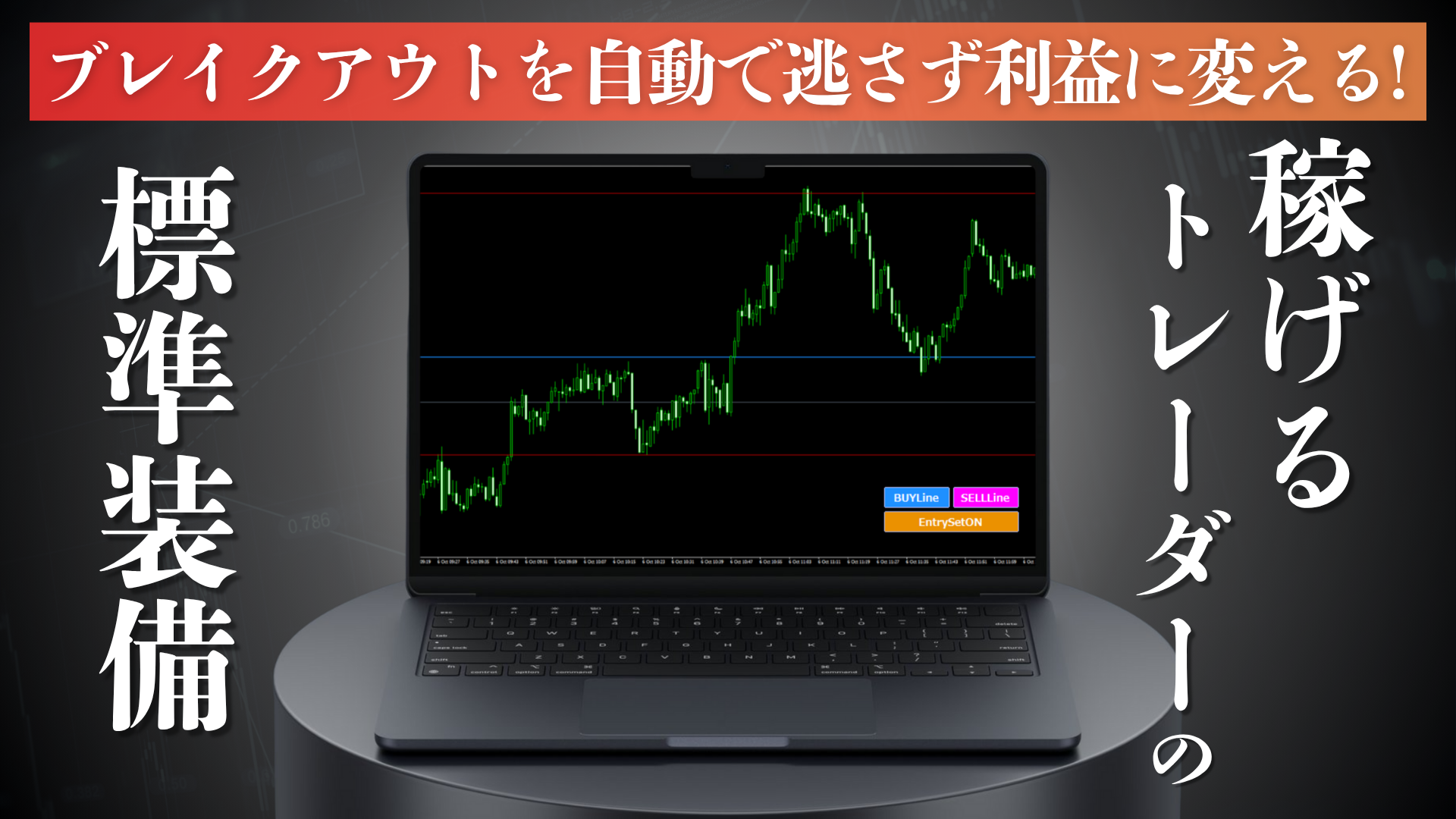
This tool monitors the lines you draw and automatically completes entries and take-profits the moment a breakout occurs.
- Trade is completed by drawing the line
- No manual操作 to miss opportunities
- Take-profit and stop-loss set automatically
In short, the trader’s job is simply to draw a good line. Breakout timing is not missed, and there are no operation errors.