

【Serial Article】A Method That Dramatically Improved My Trading! Regression to the Origin
This time Investment Navigator+ wrote about “How to Dramatically Improve Trading! Return to the Origin” content. The content is priceless. I wrote about the flow to become profitable while returning to the origin.
At that time, when I was practicing, I didn’t think about the article’s content, but looking back, there was a solidbasis that things went well.
If you are feeling lost, I have compiled this content because I want as many people as possible to grasp a “path to winning” through practical experience.
This content is a story of the time when I, who had wandered and felt a bit tired of trading, obtained awinning trigger. And it is a message intended for everyone who continues to worry about “how can I win, too.”
In particular, I would really like small traders with surplus funds of 5,000,000 yen or less to try it.
Now, in the world of trading, there is an overwhelming amount of information. SNS, YouTube, GogoJungle… Every method may claim to be correct, but you don’t know which one suits you, and in the end you become lost. Before you realize it, you are studying but lacking practical experience — I was exactly the same.
But one day, my approach to trading itself changed. It was through two seemingly simple things: “deliberate practice” and “dividing and managing funds.” After starting to practice these two, trading becamereproducible skills.
When you finish reading this book, you will likely feel:
“There’s no need to rush. The path to victory does exist.”
And if the previously scattered knowledge can be connected into one line, your trading will start to rise steadily. Use this content to take that first step forward.
I wrote this while my left eye twitched, so please treat me to one Starbucks coffee (660 yen).
無料で, a bit of method details are also written, so even if you prefer drinking coffee yourself, please read up to a point. I apologize for any typos or parts I may have forgotten.
Chapter 1: Why do so many enthusiastic people fail to win
Many people who enter the world of trading think, “I should be able to win.” But the reality is different. About 99% of people dissolve their funds partway and disappear from the market. There is a clear reason for this.
That reason isbecause they do not treat trading as a job.
Every profession has steps of “learning,” “practice,” “experience,” and “growth.” Just as a professional baseball player cannot become top-tier in a year, nor a chef be placed in charge of a renowned restaurant within a few months, trading is, I believe,a craftsman’s world.
Nevertheless, most people spend time only looking for a “profitable method,” anddo not know how to improve.
Is the only way to win in trading reallyrepetition? No matter how much theory you study and how deeply you research indicators, unless you actually look at charts and move your hands, you won’t improve. Knowledge alone won’t make you win.
If you ask a major league baseball player to teach you how to swing a bat, can you hit a home run tomorrow? Everyone knows that’s impossible. For those who have no accumulation, it’s impossible to hit a home run tomorrow, right?
Think back to your own job. How many years did it take you to become proficient? How long did it take for your junior colleagues or subordinates to reach that level?
No one was perfect from the start. You make mistakes, feel frustrated, think about it, and then challenge again. Through that repetition, you finally acquire a sense. The same goes for trading.
However, in the market world, it often seems “easy money is possible.” So when you lose a little, you feel you lack talent and you can’t continue. But in reality, it’s justa lack of experience.
Many people are not “unable to win,” but “not enough practice.” They are simply off in the direction of study and effort. No matter how much they study, in tradingpractice is everything. True understanding comes only from the charts and real trading.
If you truly want to win, start by treating trading as a job. Learn, research, practice, reflect, and practice again. The road to becoming a winning trader lies in a long, dull repetition.
However, now through GogoJungle and SNS, there is an environment where you can purchase and share the knowledge and logic that other traders have actually used. If used correctly, it saves a lot of time and helps prevent unnecessary losses.
I too joined a two-year, ¥20,000-per-month school at that time, but after starting to use this method, I began turning profitable in about three months.
Of course, every indicator or method will have compatibility with your life and money management and your prior experience.compatibility.
At first, it may feel a little hard to align, but the process of adjusting it to suit you is what will cultivate yourgenuine trading skills.
Chapter 2: A story of how fund management changed my life
If you ask what truly helped me win in trading, I will answer without hesitation.“Changing fund management.”
At first, I faithfully followed the common 1–3% loss rule. It sounds planned, doesn’t it? But after about six months, my funds were gone, and my spirit broke. (Before that, for about three years, I traded quite messily.)
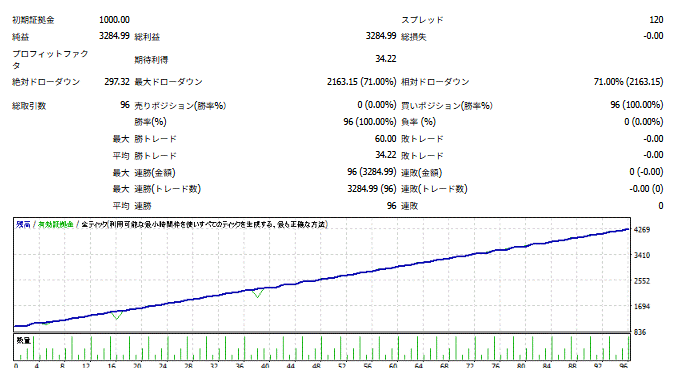
What I found and leaped forward with wasfund management by splitting 300,000 yen into 100 parts (1,000–3,000 yen per trade). I simply didn’t like losing money, so to avoid dissolving funds, and feeling a bit tired, I started with the mindset that “even if I lose 10,000 yen a day at the most in slot machines, I’d be okay,” and began operating with that feeling. Still, I loved trading, so I watched charts frequently.
Back then, trading was quite rough in hindsight, and I thought, “It’s 3,000 yen, so I don’t need to set a stop loss.” The lot size was 0.02; if the price moved about 10 dollars against me, I would incur a loss cut. At first I traded somewhat intuitively, but because I didn’t want to accept being cut immediately after entry, I gradually began to consider therelationship between SL width and entry position.
And what I realized was“Reversing on a 1-minute chart makes you go into profit quickly after entry”. As a result, the practice of “losing small” helped cultivate the ability to lose correctly. Repeating with the small unit of 3,000 yen allowed me to accumulate hundreds of experiences, and I gradually began to see the relationships between entry position, SL width, and profit-taking points.
A particularly big discovery was“For upper-timeframe horizontal lines, 1-minute reversal works”. Entering on a 1-minute reversal and following the support/resistance on the higher timeframes. Simple, yet incredibly responsive. And that’s when, for the first time, the concept of “risk-reward” clicked for me.






Is it OK?