

Gold Scalper Indicator EA Production ~ The timing to issue signals is three
Simple Logic FX Sales Page
Simple Logic FX Gold Version Sales Page
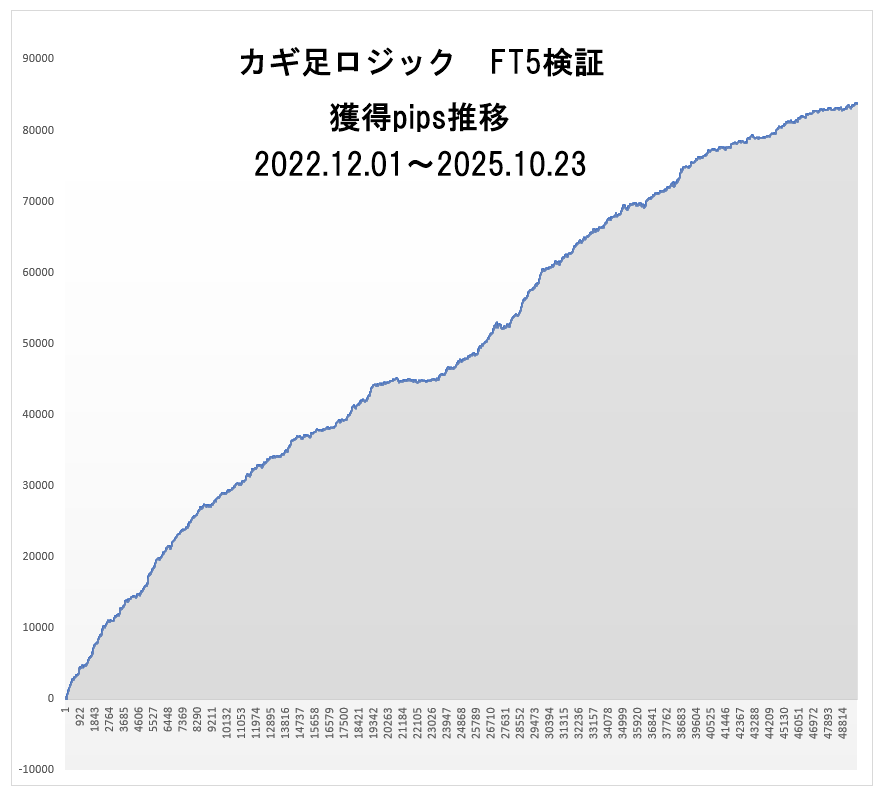
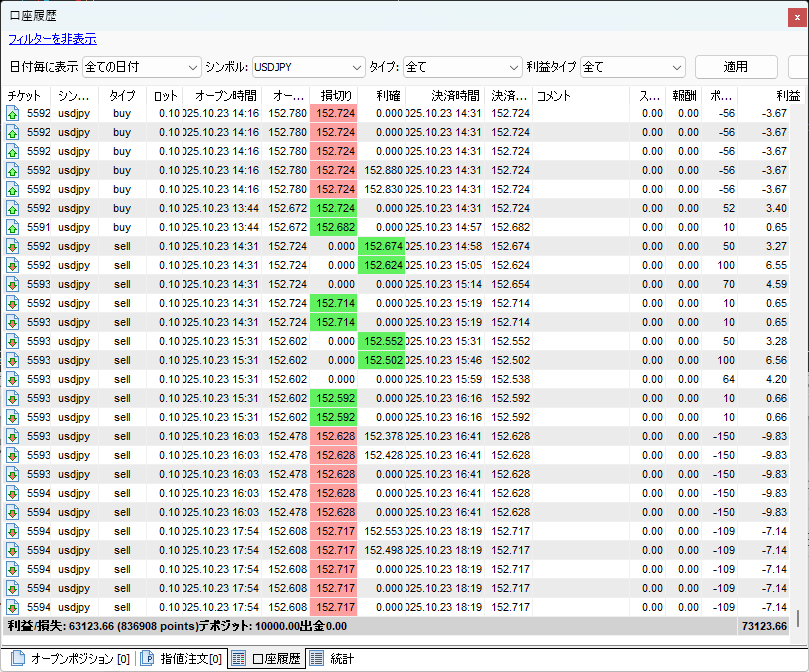
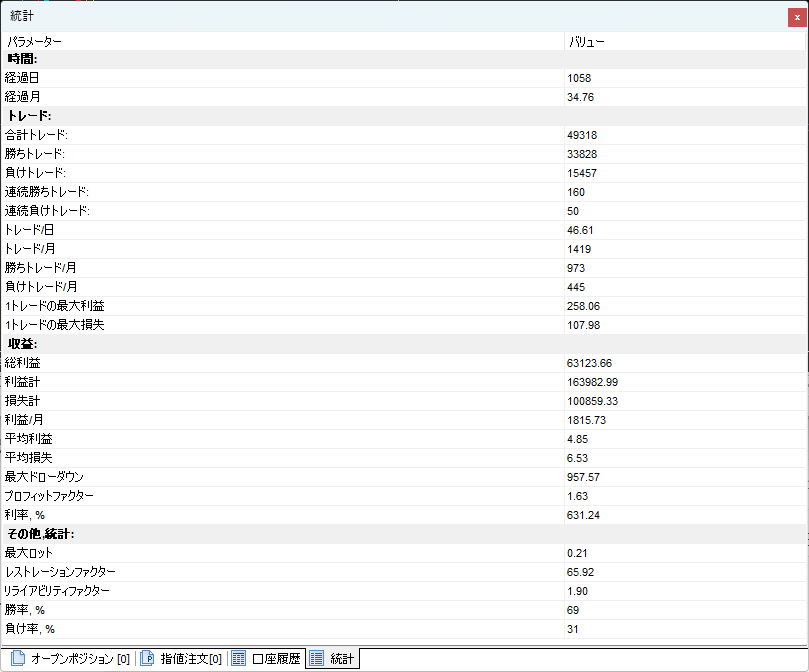
Dollar/Yen Key Foot Logic This Week's FT5 Verification Results
This week ends on a positive note.
October 17, Friday
October 20, Monday
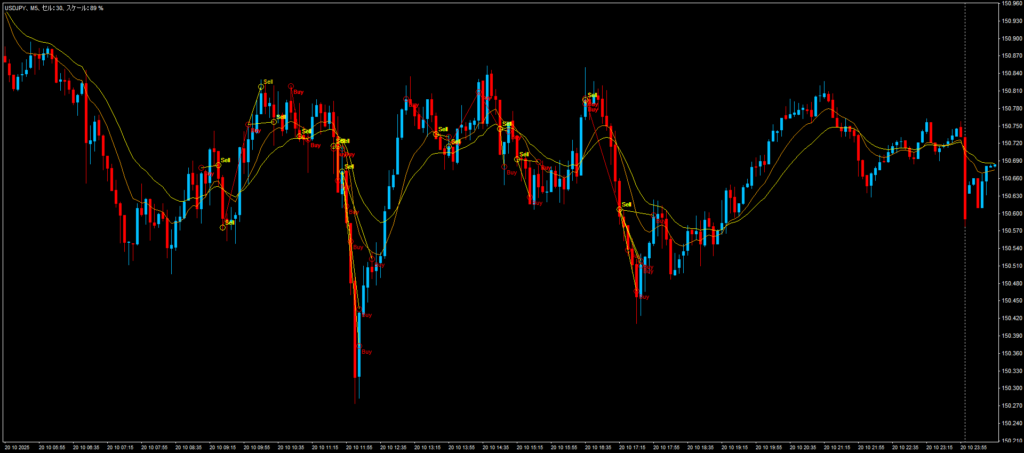
October 21, Tuesday
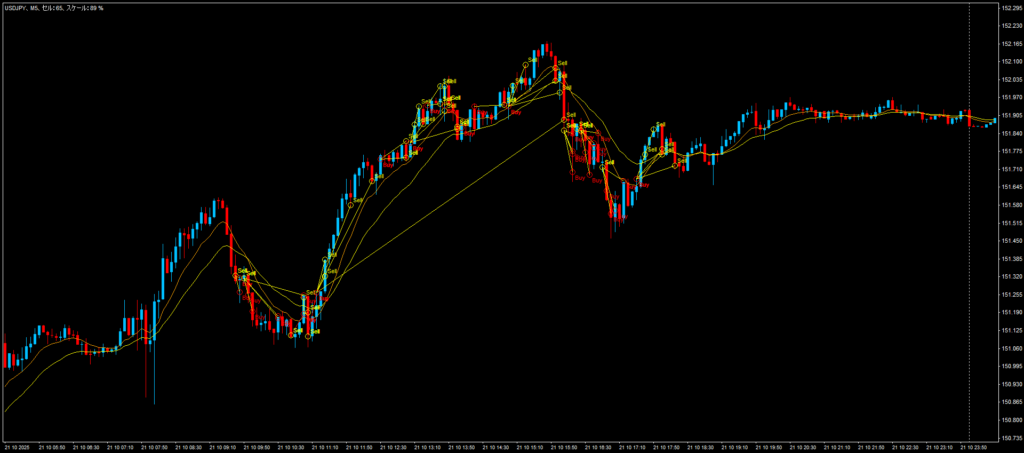
October 22, Wednesday
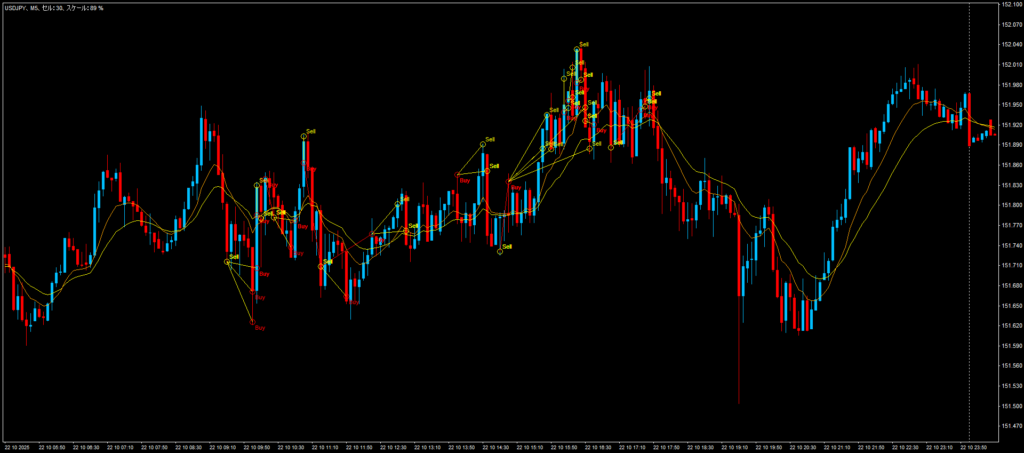
October 23, Thursday
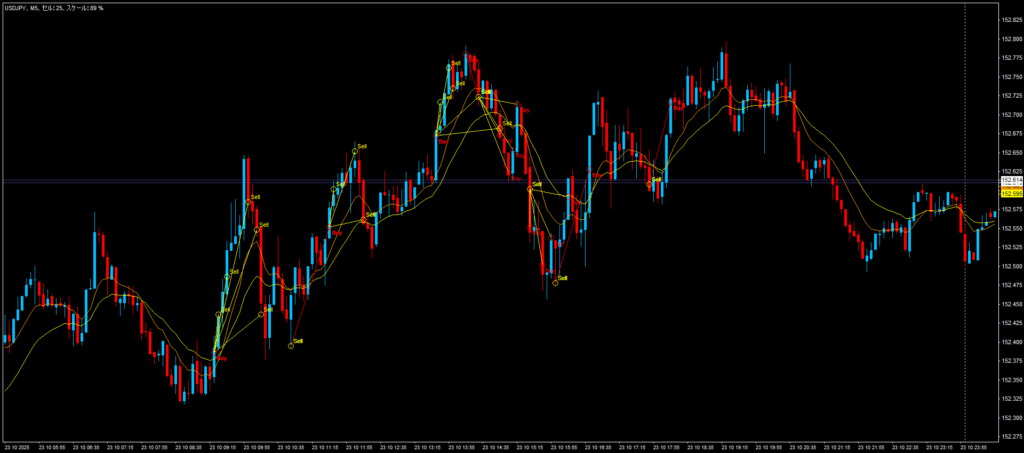
Because a partial federal government shutdown continues,
we are seeing irregular data releases.
The September Consumer Price Index (CPI) was released yesterday at 21:30, but
the employment data scheduled for early October is
still on hold.
There are 3 timings for signaling a candlestick
System B's signal indicator is almost complete.
In creating this indicator,
the most challenging part was determining the signaling timing.
Since this is my first time making a scalping indicator for Gold,
to handle its rapid moves,
I thoroughly considered at what timing to issue signals.
Also, adopting ZigZag in this logic has been a major constraint.
As anyone who has used ZigZag knows,
there is a lot of repainting.
With fast-moving 1-minute candles, it can change in an instant.
Considering these, at what candle timing should a signal be issued.
There were three options below.
① Issue a signal on the latest completed candle when its condition is met
② In the moment the candle completes, if conditions are met, signal on the latest closed candle
③ At candle completion, if the conditions on the latest candle's open price tick are met, signal on the latest candle
For someone who has never built a tool,
what does that mean?
Especially, how do ② and ③ differ?
That’s the gist, right?
But when programming, this is a crucial consideration—
extremely important.
① means signaling when the condition is met on the current live candle.
That’s easy to understand, right?
② means if the condition is met on step ① and continues to hold at candle completion, signal.
This is a pattern where you wait for candle completion to enter, which happens often.
② and ③ are almost the same conditions, but
② evaluates on the latest confirmed candle (the second from the right), while
③ evaluates on the open price tick of the latest candle (the rightmost candle).
This time, I adopted ① and ③.
① is the pre-entry timing signaling that it’s almost time to enter,
preparation signaling.
② is the actual entry confirmation signal.
At first, I built it with ① and ②, but
the ZigZag repaint and the window of when candles switch
made me modify to ① and ③.
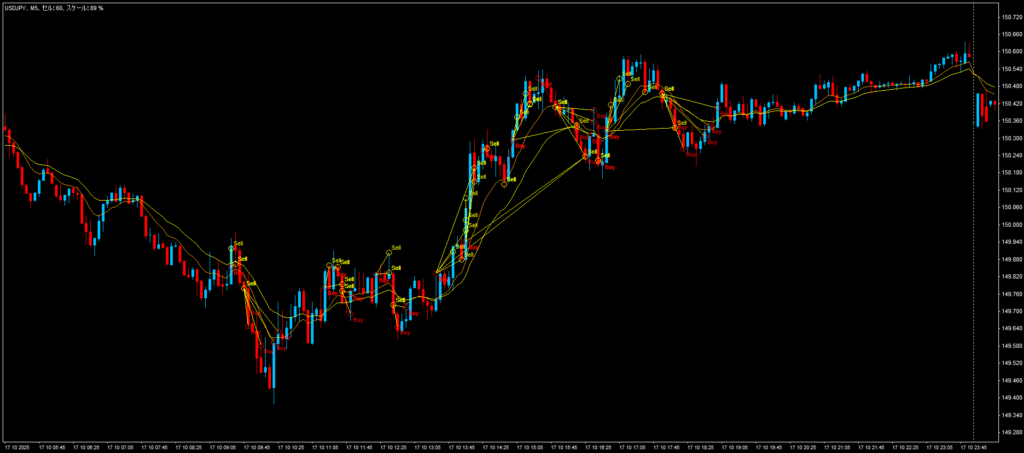
To make it easy to understand, I’ll show actual chart images below.
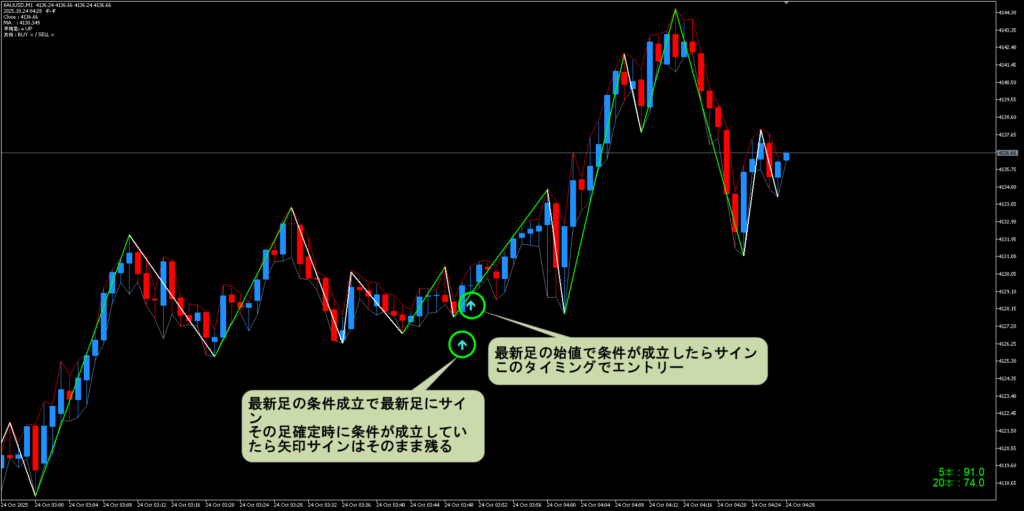
The popup alert and notification sound occur at timings ① and ③, but
as shown in the chart image above,
if the condition was met at timing ②,
the arrow signal remains on the chart.
If two arrow signals appear consecutively,
entry happens at the timing of the second arrow signal.
It’s the first time I’ve decided signal timing this strictly,
but considering scalping and ZigZag repaint,
this is the minimum necessary specification.
to always insist on as many scenarios as possible
To create indicators or EAs,
as before, you must consider all possibilities and fine-tune the details.
If you look at the exchange between K-san who built this logic and me,
you’ll understand how important it is to refine the details.
This exchange has continued from last week into this week.
――――――――――――――――――――――――――――――――
● Do. 2025.10.17
Good evening.
This is Do.
Since the new ZigZagH version isn’t finished yet,
I’ll quickly share this week’s progress.
We’ve been discussing with the programmer about Shin-Gi determination
for a while.
How to interpret ZigZag lines
took a few days to align our understanding.
Last night we reached a point where we were confident our understanding matched,
and have moved on to programming adjustments.
First, I will make the Shin-Gi determination work according to K-san’s understanding.
If the finished result is off, I will keep adjusting it.
During a recent Zoom, we received a request for additional features
Three filters (such as the Yin/Yang determination of the candle just before) will be added after we verify them.
From this interaction, we realized that the signal at candle completion tends not to work well,
so we decided to signal not on the latest confirmed candle but on the latest candle’s open price at candle completion.
(Words alone may not convey it, but I’ll explain once it’s ready.)
With this change, past candles will no longer show arrows.
As you run it, signals that have already formed will remain, but when you install on a new chart, past candles will not display signals.
Therefore, past verification will be done with Strategy Tester.
As for past candle signals, ZigZag repaint may cause positions to be different from real-time, so
we decided not to show signals on past candles to avoid user confusion.
We thought about this as well.
We’ll keep you updated on progress.
It has taken longer than expected,
so you’ll be waiting a bit longer,
thank you for your understanding.
With appreciation
Do.
● Mr. K 2025.10.18
Dear Do
Hope you’re well. This is K.
Thank you for the progress update.
I also checked the movement using Strategy Tester with the indicators you previously provided.
The repainting of ZigZag made me realize again how difficult it is to construct the logic.
I think signaling with ZigZag itself is amazing.
The programmer must be struggling quite a bit, I imagine.
Regarding the previously provided indicators,
they are closer to the ideal than I expected.
If the waves are Shin-Shin-Gi,
on the latest value ZigZag color indicates
we’re waiting for Shin-Gi entry, and
as a filter, if ZigZag moves away from the latest value
we wait for Shin-Gi entry while ZigZag is attached to the latest value,
and we wait for the previous Shin-Shin when ZigZag is not attached to the latest value.
In the first phase, decide by Shin-Gi color,
and whether ZigZag attaches to the latest value to determine the basis of the latest ZigZag or to go back one step.
For example, when waiting for Shin-Gi entry and moving to Gi-Gi,
without eliminating the possibility of Shin-Gi and Gi-Gi entries, always decide on the latest value, which is wonderful.
I can’t come up with this on my own,
and I feel everyone’s wisdom is coming together
and bringing us closer to completion.
When it’s completed, I might cry with emotion.
I will continue testing within my capacity as well.
So I’m looking forward to the latest version of the indicator.
Please continue to support us.
● Do. (Part of email) 2025.10.21
This time, the Shin-Gi determination was corrected.
We fixed the issue where the latest ZigZag line could not be used in the determination
and ensured the latest ZigZag line is always included in the determination.
Also, the rare yellow line (which can become exactly the same price as the most recent peak, making determination impossible) has
not been included if it falls within the latest two ZigZag lines.
The latest ZigZag line filter has not yet been installed, so
there may be signals you don’t want to appear.
Please consider this as well and let us know where you want signals to appear or not appear.
During testing, please feel free to be as demanding as possible.
By repeating additions, changes, and fixes
we hope to get closer to a standard.
――――――――――――――――――――――――――――――――
“Please be as demanding as possible”
I’ve told K-san this, and
this is truly important.
No matter the logic,
as long as you can clearly articulate it in writing,
it’s almost realizable, so
during production, keep being as demanding as you can.
I know it can be a nuisance for the programmers, but
we’ve never held back on asking for it.
As a result, Simple Logic FX System A has
become a tool highly valued by everyone (Simple Entry, Simple Limit).
We could complete it thanks to the cooperation of all users who continued to demand more after release.
I am grateful to the users who kept making demands.
Progress of Simple Logic FX
This week’s main topic has been progress on System B.
With the signaling indicator nearly complete,
the next step is creating the verification EA.
Early next week we’ll finalize the specifications
and request the programmer to implement it.
The timing of signals will determine the risk-reward for entry,
so for a simple EA, just a little more work remains.
However, this time we plan to adjust risk-reward based on entry timing and
include a more complex capital management logic, so it will take more time.
So have a wonderful weekend.
Simple Logic FX Sales Page
Simple Logic FX Gold Version Sales Page