

My view: "Differences between people who succeed in trading and those who fail"
Reviews & videos can be viewed here
Good morning everyone.
Yesterday's USD/JPY moved in a weak way that didn’t even reach 1 yen.
Today is the Liberal Democratic Party leadership election, so that may have had some influence as well...
Even if Ms. Takai (Takahashi) becomes leader, I don't think the situation will change much, but if Ms. Takai becomes leader, there are too many old men whose convenient arrangements are troubled, and there are criminal-level events like SJS (Sadao) propaganda artillery, etc.
But it's a terrible situation.
If what I read somewhere is true, that a former Self-Defense Forces official wrote in a book that
“In our world, the nation of Japan does not exist.”
and whether that's actually true, it's now a reality in the current relationship among the US, Japan, and China.
If the world on that side is interconnected and friendly, and there are talks to divide Japan in half between the US and China...
Like Liam Neeson or Jason Statham in movies, the only remaining path may be to strengthen self-defense capabilities.
Now, the Nikkei averages show no signs of stopping.
This is a “bubble.”
Perfectly a bubble.
Japanese stocks are being hyped as “undervalued” from a global perspective, which fuels a buying frenzy.
History repeats itself, but there will be few investors who rush to exit during this bubble.
On the contrary, they keep saying, “Keep buying!”
“It's not over yet!”
and keep buying.
Well, that is the bubble, but every bubble in history is later acknowledged as such.
By then, it's already too late.
Historically, both the market and land prices have reached all-time highs.
If you buy now, you’ll end up catching a high, but that’s something you won’t know until later.
What you can do now is establish a risk-avoidance strategy.
If everything continues rising, we Japanese may face an environment never experienced before.
Some may say it would be nice if stock prices and land prices rise, but that also points to hyperinflation.
If you don’t sell stocks or land, you won’t have cash.
What will you do if you sell?
If you don’t sell, how will you cope with inflation?
Eventually, this issue will arise.
Right now, this may not affect those who have abundant cash.
Going forward, expenditures will far exceed income.
One example: the Bank of Japan, which ended negative interest rates three years ago and began raising rates, leading to five-year adjustable mortgage rates and more refinancing consultations.
Couple loans will be very tough.
The inability to refinance in many cases suggests that “couple loans” and “parent-child relay” housing loans could become subprime and trigger a subprime shock in the US.
Like residual car loans, the issue arises when you try to buy something without cash.
Banks and car dealers don’t suffer losses.
Only the buyers lose out.
If the mortgage is labeled
“Long-term, bankruptcy-proof, absolutely repayable mortgage”
would anyone borrow?
From now on, the BOJ will continue to raise rates.
In the first place, a weaker yen due to a lack of national strength will push up all prices.
Prices have already risen, haven’t they?
All commerce will be affected.
This is an arrival of unprecedented hyperinflation.
Even if the value of the yen falls, it ends up being cash in the end.
Being “landowners” is better than being “rich.”
If you become disgusted, moving overseas may help you dodge a yen depreciation.
Health comes first for that.
For us common people, the remaining option is not long-term investing but short-term speculation.
Having a part-time job, two jobs, or three jobs, turning time into money, is that a kind of speculation as well?
A trader who participates in the market should aim to collect small sums every day.
Yesterday's USD/JPY 1-hour & 1-minute charts
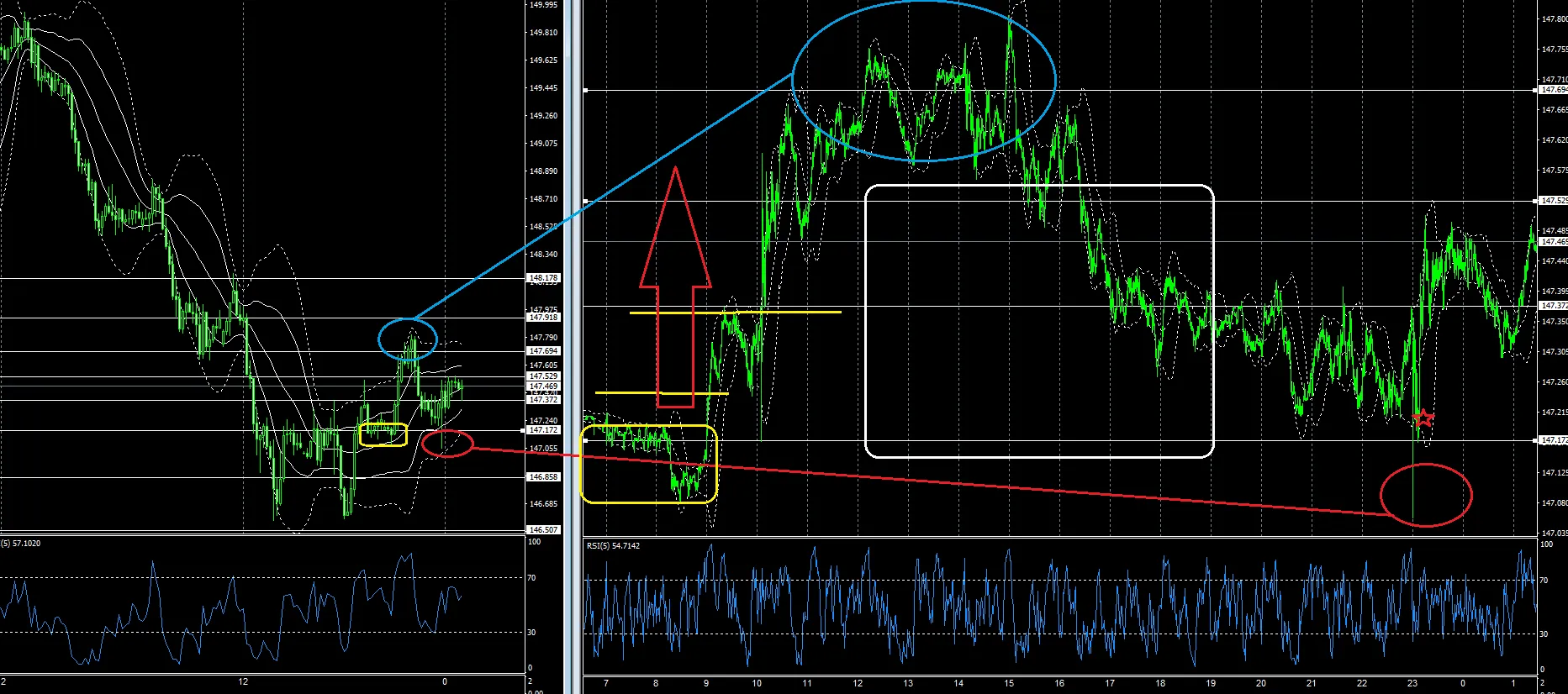
The reach point I wrote in yesterday morning’s article was the blue and red circle with the yellow square.
At Tokyo open, a long breakout could be tested.
Then the blue circle reached, forming a range, and from London open the price fell starting from the white blank-zone billion-trading line, and then rose again.
At 23:00, the indicator dropped to the yellow square zone, then rebounded and rose.
As I always write, it develops as described.
Whether you catch the initial move or wait to gain a directional signal first is a matter of timing and preparation.
For the billion-trader users, you can view charts in three patterns: breakout, volume, and switching between buy and sell, so I think it’s fine to enter from the scene where you excel.
However, once you’re used to it, covering all three patterns is essential.
You already have material that matches the current market, so it’s a matter of repeated verification and practice.
Like daily brushing, the results change greatly depending on whether you continue every day.
In conclusion
The difference between those who succeed in trading and those who fail is
those who fail try to find rules and patterns on charts
those who succeed look at charts flexibly and from multiple angles
The three products I recommend as a trader are the following.
The New Billionaire Trader Scalping – Volume Plus
FX Trading Not Your Average Hedging
Explosive Indicator – Turning into a Winning Trader
× ![]()