
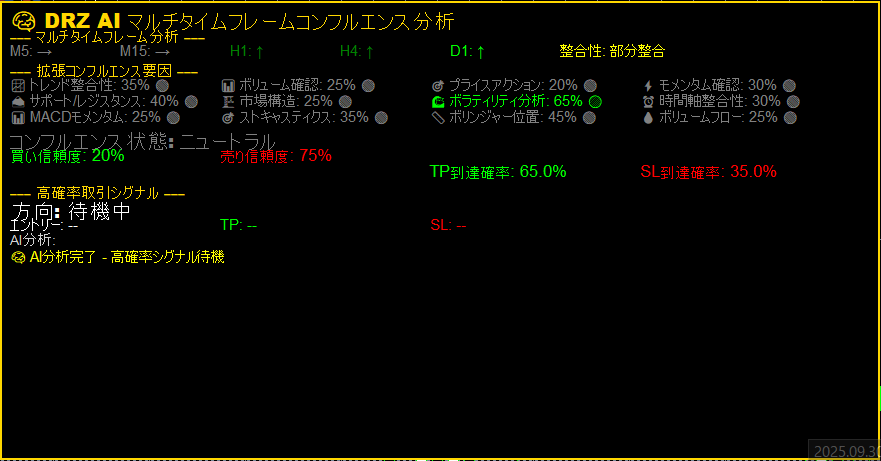
What is DRZ (Dynamic Reversal Zoning)? A super simple explanation
What is DRZ (Dynamic Reversal Zoning)? A Very Simple Explanation
DRZ stands for Dynamic Reversal Zoning. It is a trading method that identifies price zones where prices have repeatedly reversed in the past and uses that information to trade.
tradedevils-indicators.com
. On the chart, these zones appear where a pullback occurs in a downtrend or where a bounce occurs in an uptrend. It’s like the price hitting a floor (support) and bouncing, then hitting a ceiling (resistance) and dropping.
ig.com
. In DRZ, Fibonacci retracement is overlaid on past highs/lows and wave retracements to visually indicate where prices are likely to rebound.
tradedevils-indicators.com
。
The figure below is an example of the USD/CAD daily chart. You can see prices bouncing in the blue shaded area (Liquidity Zone). Methods to find such reversal zones include the following:
Overlaps of highs and lows: If a price zone sees repeated rebounds, that is a support/resistance zone. In practice, support and resistance are often treated as zones with a certain width rather than a single precise line.
ig.com
。
Trendlines: Points where an uptrend and a downtrend line cross, or channel lines, can become reversal zones. In particular, crossovers of trendlines drawn on different timeframes are zones where market psychology tends to congregate and are important.
fxtrendo.com
。
Fibonacci retracement: Lines showing retracements of 38.2%, 50%, etc., relative to the latest wave, with levels where price often reverses treated as zones.
tradedevils-indicators.com
。For example, when there is an uptrend, draw Fibonacci retracements at the start and peak and focus on levels where pullbacks tend to occur.
Entry Methods (Buy/Sell Timing)
To enter at a reversal zone, wait for signs of price reversal. Concrete examples include:
Candlestick reversal patterns: After reaching the zone, if you see a long lower wick bullish candle (bounce from the lows) or a long upper wick bearish candle (rejection at the highs), or a bullish/bearish engulfing pattern (a large bullish/bearish candle enclosing a smaller opposite candle), these are signals of a rebound. Consider buying (selling) when these patterns appear.
RSI (Relative Strength Index): When RSI is 30% or below (oversold), and price is in a support zone, it’s a buying opportunity. Conversely, when RSI is 70% or above (overbought) and price is in a resistance zone, consider selling.
investopedia.com
. RSI is an oscillator used to aid in determining potential reversal points.
MACD: When the MACD line crosses above the signal line (golden cross), it’s a buy signal; when it crosses below (dead cross), it’s a sell signal.
investopedia.com
. MACD indicates momentum of the trend, so when momentum changes near zones, it helps guide entries.
Confluence with the Trend: The overall trend direction is also important. In a long-term uptrend, buy entries at zones; in a downtrend, sell entries, which increases safety.
Exit Methods (Take Profit / Stop Loss)
Once you enter a trade, predefine your stop loss and take profit rules:
Stop Loss: If the price clearly breaks through the reversal zone, exit the position. For example, if you bought in a support zone and the zone is broken below, cut loss. Likewise, if you sold in a resistance zone and it breaks above, cut loss.
Take Profit: If the price reverses as expected, aim for the next opposite zone or the recent high/low to take profit. Generally, a risk-reward ratio of 1:1 or higher is a guideline, and the usual strategy is to buy at support bounce and sell at the next resistance, or sell at resistance bounce and buy back at the next support.
babypips.com
。
Supplementary indicators and chart patterns
There are tools and patterns that pair well with DRZ:
Fibonacci Retracement
tradedevils-indicators.com
: A tool that quantifies wave retracements; retracement levels like 38.2%, 50%, 61.8% indicate likely reversal zones. In DRZ, draw Fibonacci lines within the zone to pinpoint reversal points more accurately.
tradedevils-indicators.com
。
RSI and Stochastics
investopedia.com
: RSI and Stochastics are oscillators indicating overbought/oversold conditions. In particular, when RSI drops to 30% near zones, rebounds become more likely.
investopedia.com
。
MACD
investopedia.com
: As mentioned, MACD golden cross and death cross are strong reversal signals. Using both MACD and RSI increases the reliability of reversals.
Chart patterns: Clear reversal patterns such as double tops/bottoms and head-and-shoulders (inverted) can be useful. For example, a price forming two peaks and reversing at the same level, a “double top,” is a selling signal.
Moving averages: It is common for price to bounce near the 50-day or 200-day moving averages. Being aware of rebounds near major moving averages as zones is beneficial.
Summary (Illustrative Example): DRZ is like identifying floors and ceilings where prices tend to bounce. For example, just as a ball rebounds when it hits a glass floor, prices tend to bounce at support zones.
ig.com
。By using this property, buying/selling as the zone is reached allows even beginners to aim for reversals with a simple trading approach.
References: DRZ definitions and methods are explained by TradeDevils
tradedevils-indicators.com
, concepts of support/resistance
ig.com
ig.com
, how to use oscillators such as RSI and MACD
investopedia.com
investopedia.com
etc. The sources are cited within the text.
DRZ analyzed by DeepSeek!
Why not ChatGPT but DeepSeek?