

Will translations be replaced by AI? An analysis of Translation Center (2483)
Translation Center (2483)is a company engaged in industrial translation such as medical and industrial sectors, as well as dispatching translators and telephone interpretation services.
Industry-leading and solid management base
Translation companies are mostly small, but the company expanded and went public. It is stillthe industry’s largestleader.
With globalization of corporate activities, demand for industrial translation is increasing. Accordingly, the company’s performance has continued to grow.
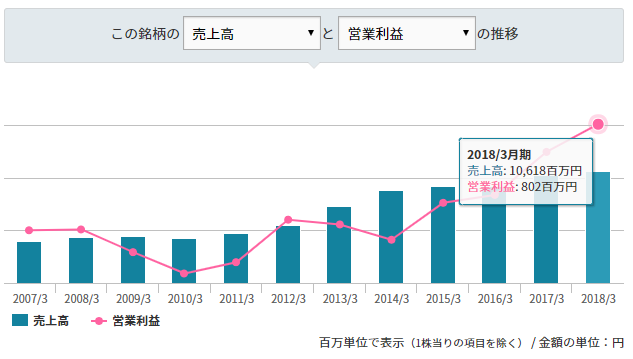
What should be noted isthe rise in operating profit margin. From the fiscal year ending March 2014 to March 2018, it rose from 4.1% to 7.5%. While not necessarily high in absolute terms, this indicates improved business efficiency.
This is made possible by the position of being the industry’s largest. Industrial translation requires domain-specific knowledge, and simply knowing a language does not immediately enable one to imitate it.
In other words,the more volume, the more knowledge and know-how accumulate, leading to increased efficiency and more projects at the same time.
With the increase in inbound tourists and the like, the market continues to expand, and the management environment looks solid for the time being.
The biggest rival is AI, but …
However, the biggest concern isthe risk that translations will be overtaken by AI.
Now, with Google Translate, translating even a small website is largely feasible. Although industrial translation is more difficult than general translate, there are patterns, and with effort, it can be done.This seems to be only a matter of time.
In that case, the translation center’s possible options are as follows.
- Somehow survive until caught up
- Focus on domains difficult for computers (interpretation, etc.)
- Adopt computers themselves
Regarding 1, computers are good at English-to-Japanese translation but not so good at Japanese-to-English. This is attributed to the smaller number of Japanese-language users compared to English and the fact that Japanese subjects are often omitted.The hurdle for Japanese may still be high.
Regarding 2,they have acquired ISS, a translation/interpreting service company. With the increase in inbound visitors, communication between doctors and foreign patients in medical settings is an issue. There could be synergy with industrial translation.
Regarding 3, this also seems to be an extension of the current strategy. The company proclaims “ proposals to improve translation efficiency using various tools and software and does not fear computers; instead, it uses them. The improvement in operating profit margin is likely due to this, and even if translation unit prices fall, there may be further savings in personnel costs.
Viewed this way, there seems to be no obvious blind spot in the near term. However, we must also anticipate the possibility that technology could suddenly emerge to break through these barriers all at once.
Should you invest in Translation Center?
The company is currently listed on JASDAQ, butit appears to nearly meet the requirements for listing on the Tokyo Stock Exchange First Section.
In general, when a company is listed on the First Section, its stock price tends to rise at that moment, so that is something to anticipate (though the timing and rate of increase cannot be guaranteed).
Looking at the stock price, it has fallen in line with market trends, andPER is 13 times. No-debt managementNo-debt managementand stable finances.
From the perspective of business direction and stock price levels, the timing for investment does not seem bad. I will continue to monitor closely in the future.